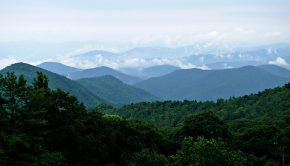
Episode 91: Dinosaurs of Appalachia
May 24th, 2018 | by David Marshall
The Appalachian mountains, span the Eastern margin of the United States of America. They are predominantly composed of Paleozoic rocks, [&hellip

May 24th, 2018 | by David Marshall
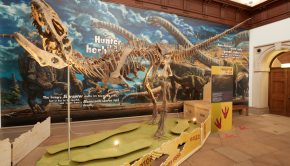
The Appalachian mountains, span the Eastern margin of the United States of America. They are predominantly composed of Paleozoic rocks, [&hellip
May 3rd, 2018 | by Liz Martin-Silverstone
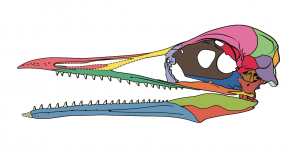
Bird evolution has long fascinated palaeontologists. Despite crown-group birds (birds giving rise to modern lineages today) evolving during the Cretaceous, [&hellip
April 17th, 2018 | by Liz Martin-Silverstone
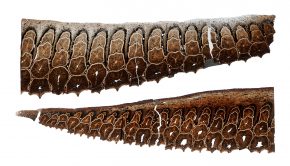
Tooth shape and arrangement is strongly linked with diet, and palaeontologists often use teeth to determine what kind of food [&hellip
April 6th, 2018 | by David Marshall
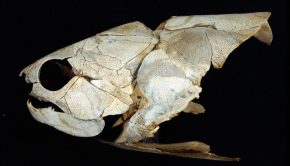
The buculum is a bone present in the head of the penis of most mammals. Whilst a few mammals, like [&hellip
March 17th, 2018 | by David Marshall
Archaeopteryx is perhaps one of the most iconic taxa in the fossil record. Exclusively found in the Late Jurassic Solnhofen [&hellip
February 1st, 2018 | by David Marshall
The Carboniferous (Latin for ‘coal-bearing’) is a period of the Paleozoic Era named after the massive accumulations of coal that [&hellip
January 7th, 2018 | by David Marshall
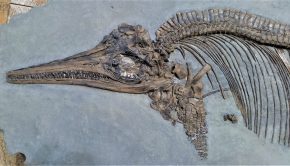
Ichthyosaurs are large marine reptiles that existed for most of the Mesozoic Era. The most familiar forms superficially represent dolphins, [&hellip
January 6th, 2018 | by David Marshall
Geology, as a subject, has for the most part assumed that there were no fossils to be found earlier than [&hellip
December 1st, 2017 | by Guest Blogger
Professor John Long is an early vertebrate researcher at Flinders University, Australia. He is most famous for his work on [&hellip
October 17th, 2017 | by David Marshall
‘Dinosaurs of China’ at Wollaton Hall, Nottingham, UK, is a one-time only world exclusive exhibition of dinosaurs. Featuring fossils and [&hellip


 Episode 173: Petrified Forest
March 17th | by
Episode 173: Petrified Forest
March 17th | by
 Episode 172: Rhynchocephalians
February 5th | by
Episode 172: Rhynchocephalians
February 5th | by
 Episode 171: Freshwater Mosasaurs
December 12th | by
Episode 171: Freshwater Mosasaurs
December 12th | by
 Society of Vertebrate Paleontology Annual Meeting 2025
December 3rd | by
Society of Vertebrate Paleontology Annual Meeting 2025
December 3rd | by
 Episode 170: Cariocecus bocagei
September 15th | by
Episode 170: Cariocecus bocagei
September 15th | by