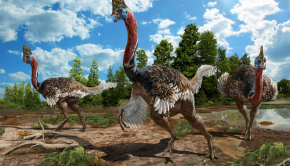
New Oviraptorid Shows Cassowary Convergence
July 29th, 2017 | by Chris Barker
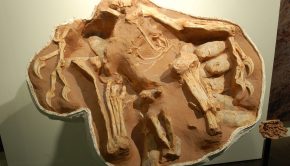
The Late Cretaceous rocks of Ganzhou, China, are rife with oviraptorids. We have seen these strange theropods before here at [&hellip

July 29th, 2017 | by Chris Barker
The Late Cretaceous rocks of Ganzhou, China, are rife with oviraptorids. We have seen these strange theropods before here at [&hellip
July 18th, 2017 | by Guest Blogger
“Must go faster!” yells Dr Ian Malcolm, as his mangled, yet rather toned, body was hauled away in the Jurassic [&hellip
July 7th, 2017 | by Guest Blogger
Implications for Dinosaur Nesting Behaviour and Thermophysiology Oviraptorosaurs had received a pretty bad reputation when they first popped onto the [&hellip
June 30th, 2017 | by Liz Martin-Silverstone
When thinking of palaeontology in Asia, most people think of Mongolia and China, but there is actually a significant palaeontology [&hellip
June 26th, 2017 | by Guest Blogger
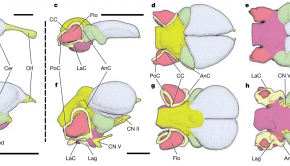
With advancements in computed tomography (CT) scanning comes an increased understanding of the internal structures preserved in extant and extinct [&hellip
June 18th, 2017 | by Guest Blogger
Articles on dinosaur neurovasculature are like buses: you wait for most of the Phanerozoic for one to arrive and then [&hellip
June 17th, 2017 | by David Marshall
A new species of Cyclotosaur, a giant salamander-like amphibian, has been described from the Late Triassic rocks of East Greenland. [&hellip
June 15th, 2017 | by David Marshall
The proboscideans are a group of animals that contains the elephant and mastodont families. Many of us will be well-aware [&hellip
May 15th, 2017 | by David Marshall
The shape of an animal is a reflection of the way it interacts with the physical world around it. By [&hellip
May 4th, 2017 | by David Marshall
A team of researchers, led by the University of Bristol, has uncovered that ancient fossils, thought to be some of [&hellip


 On the origin of my first species: Dinodontosaurus isiyavamanda
September 18th | by
On the origin of my first species: Dinodontosaurus isiyavamanda
September 18th | by
 Episode 177: Cambrian Fecal Revolution
August 17th | by
Episode 177: Cambrian Fecal Revolution
August 17th | by
 Episode 175/176: Insect Gigantism
May 2nd | by
Episode 175/176: Insect Gigantism
May 2nd | by
 Episode 174: A History of Dinosaurs in 50 Fossils
April 15th | by
Episode 174: A History of Dinosaurs in 50 Fossils
April 15th | by
 Episode 173: Petrified Forest
March 17th | by
Episode 173: Petrified Forest
March 17th | by